

Shoemaking 101: The Process for Handcrafting Leather Shoes
Ever wonder how a pair of handmade leather shoes really comes together? At Adelante, each shoe is crafted using generations-old techniques, high-quality patterns, specialized equipment, and the finest leather. We take pride in our shoemaking process because it's uniquely personal. We carry no inventory — our expert cobblers make shoes to order, so your shoes are crafted just for you. Here's how we handcraft beautiful made-to-order shoes that will last a lifetime.
Step 1: Cut and Sew
All footwear uppers are cut by hand here at Adelante. Product quality begins with the leather, and we love full-grain because it's durable, soft, and gets even better with age. To make the upper of a shoe, craftsmen first select the best section of leather, place the pattern pieces, and cut in a fluid motion.
Next, craftsmen carefully stitch the pieces together. Precision is key here — sewers must maintain alignment between pieces while guiding the needle around corners and along imaginary lines. The sewn uppers are then ready for lasting.
Step 2: Onto the Lasts
In this next step, the uppers are stretched by hand over lasts, or shoe molds, that we carry in any size and width you could imagine. This is where the craft process reaches a whole new level — in fact, this step takes such skill that we actually introduce our customers to the craftsman who lasts their shoes. The footbed is first nailed to the last, and then the leather upper is stretched over the last with pliers and secured with small nails to ensure the perfect shape.
Step 3: Welting
Goodyear welting is considered the gold standard of shoemaking, and we use this technique to craft every style of our men's and women's handmade leather boots and many of our shoes. To begin the welting process, your craftsman takes a strong strip of fabric and fastens it around the perimeter of the footbed. Next, he'll take a leather welt strip, skive it down, feed it into the Goodyear welting machine and position the shoe. The machine's needle will penetrate through the welt strip, the fabric wall, and the leather upper to make a watertight seal. The open space in the bottom of the shoe is then filled with cushioned memory foam for comfort and a steel shank for durability.
Step 4: Crafting the Sole
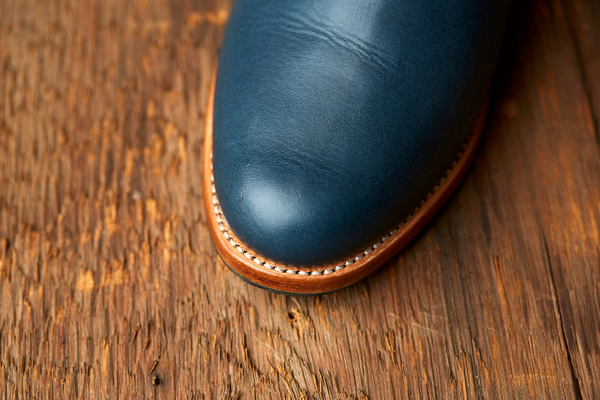
Next, a strong piece of soling leather is stitched onto the bottom of the shoe to form the midsole. This is the exposed stitch you'll be able to see when looking down at a pair of finished Goodyear welted shoes. Next, the heel is formed from pieces of strong soling leather nailed together. This is a genuine stacked leather heel, which is much more durable than a cheaper imitation heel, usually made of plastic. If you've elected to have a rubber sole protector, the craftsmen will cement this onto the bottom of the shoes.
Step 5: Finishing Touches
In the final stages, the shoes pass through quality control to ensure everything is perfect. The craftsmen clean the leather and polish the heels, prepping the shoes to be boxed and shipped to your door. One special detail you'll notice on your Adelantes is that they're individually signed — the cobblers are proud of their work, so they sign the inside of each pair that they make.
Invest in a Pair of Handcrafted Leather Shoes
The Adelante shoemaking process is incredibly complex, and requires the care and attention to detail of highly skilled artisans. All Adelante shoes are made-to-order, which provides a level of personalization and connection that you won't find in any other shoe brand. Made-to-order also unlocks a full spectrum of sizes not available elsewhere: men's wide width leather shoes, women's wide width leather shoes, men's extended size shoes, women's extended size shoes, and 9 different calf widths in women's tall boots. Experience the magic of made-to-order and invest in a pair of our men's or women's leather shoes today.
Frequently Asked Questions
How long does it take to handcraft a pair of leather shoes?
Each pair involves multiple hours of skilled handwork across five stages: cutting and sewing the leather upper, lasting, Goodyear welting, crafting the sole, and finishing. From the time of order, the complete process — including artisan production, drying time between stages, quality inspection, and shipping — takes approximately six weeks.
What is shoe lasting and why does it matter?
Lasting is the process of stretching and shaping the leather upper over a shoe-shaped mold called a last, which defines the final shape of the finished shoe. It is one of the most skill-intensive steps in shoemaking — the craftsman uses pliers to stretch the leather precisely over the last and secures it with small nails. A well-lasted shoe holds its shape over years of wear. Adelante carries lasts in every size and width, which is what allows each shoe to be built to fit your specific foot dimensions rather than a generic standard.
What makes handmade leather shoes better than factory-made shoes?
Handmade leather shoes differ from factory-made shoes in several ways: the leather is hand-selected for quality, cut by hand using pattern pieces, and stitched with the precision and consistency that automated machines cannot replicate. Each pair is inspected individually throughout production. Handmade Goodyear welted shoes are also resoleable — the sole is stitched rather than glued, so it can be replaced by a cobbler when it wears down. Most factory-made shoes use cemented construction and cannot be resoled. When the sole goes, the shoe is finished.
Do handcrafted made-to-order shoes come in non-standard sizes and widths?
Yes. Because every Adelante shoe is built individually to order, the full spectrum of sizes and widths is available: men's sizes 4 through 17 (including every half size) in widths C through EEEEE; women's sizes 4 through 15 in widths A through EEE. Made-to-order also allows for split sizing — a different size or width for each foot — and 9 custom calf widths in women's tall boots. None of these options are possible with factory production.